2019: After the Fall of New York – 1983
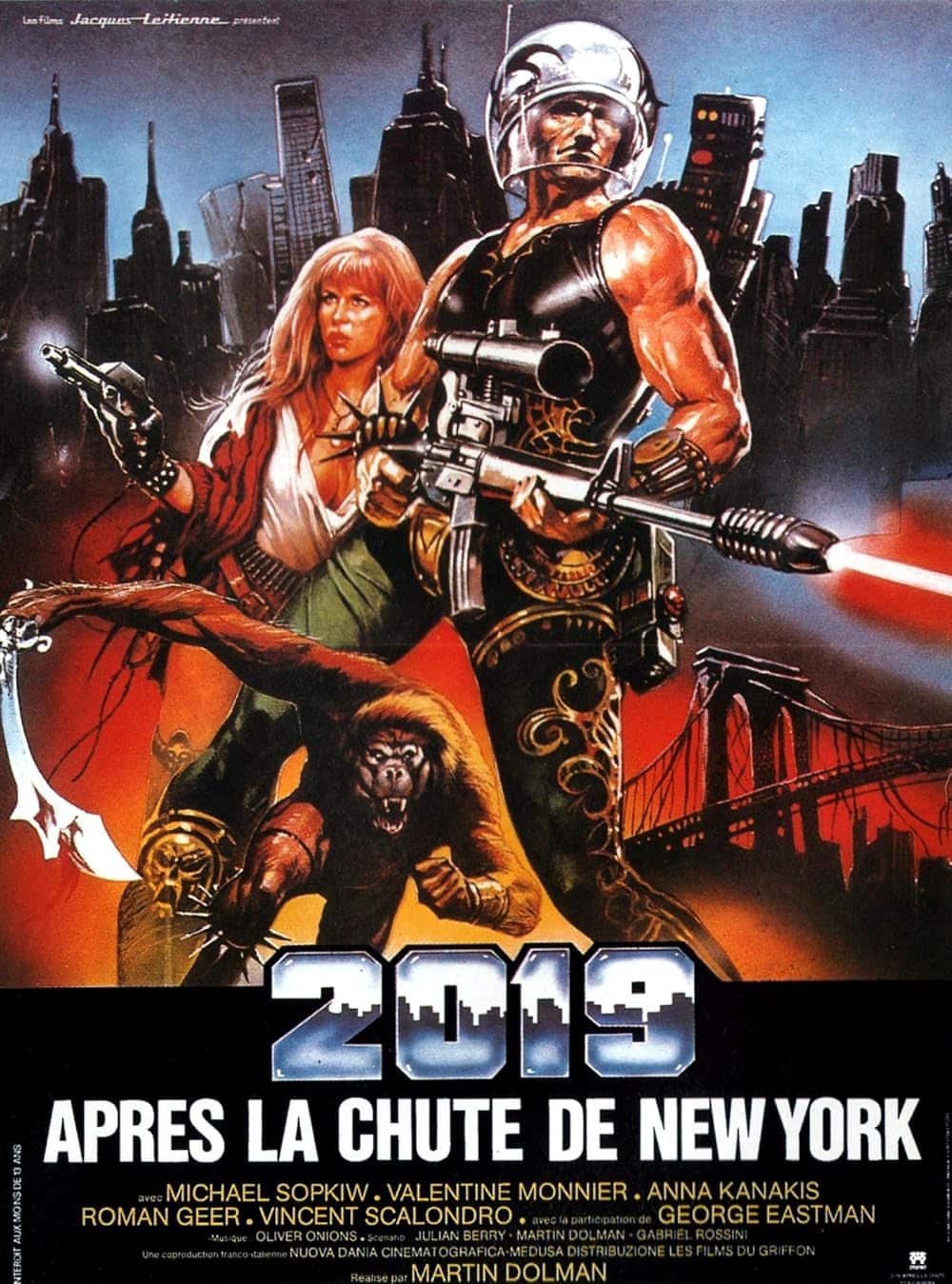
After the great nuclear war, two opposing factions emerge: the malevolent Euraks and the revolutionary Federation. Yet neither side is particularly scrupulous about the methods required to achieve its objectives — or to secure its own survival. Humanity has become sterile and is facing extinction, but rumors persist that one fertile woman still remains. She is being kept hidden deep within the ruins of what was once New York City.
The mercenary Parsifal (Michael Sopkiw) is presented with an ultimatum by the Federation — retrieve her, or die. To assist him, he is given companions who appear to possess superhuman strength and abilities that prove useful during the arduous mission. Everyone stands against them: the Euraks, as well as the local mutants who consider the territory their own. At least until they receive help from Big Ape (George Eastman).
In some peculiar way, this film feels both like a collection of clichés and like a template that others would later follow. By clichés, I of course mean the mandatory ingredients of a film of this kind — a faction that views itself as a master race, with ideological undertones that easily drift toward Nazi or fascist metaphors. We also encounter a number of mutated groups in one form or another, and the film would hardly function without these stereotypes. They simply have to be there; otherwise it would neither work nor entertain.
This, inevitably, also makes it somewhat norm-setting. I have no precise sense of where it sits on the timeline compared to other films of its kind, but I appreciate that it emerged around the same time as a cluster of similar productions.
It is surprisingly well made, even if the sets occasionally resemble scale models — something easily forgiven given the film’s age and its likely modest budget. The narrative itself is not revolutionary, yet undeniably appealing. There is no need to complicate matters further for it to captivate — even to fascinate. The premise is straightforward: safeguard the continued existence of humanity, regardless of the personal sacrifices required. Both surviving factions naturally believe they are entitled to the last fertile woman on Earth, so that they may propagate their genes and secure dominance over the other.
The characters are spot-on. They may not be portrayed with unwavering credibility in every nanosecond of the runtime, but more than sufficiently so for this to become a highly entertaining film. George Eastman makes a brief appearance as Big Ape, and it suits him perfectly. He is absolutely brilliant, and the makeup effects throughout the film are consistently impressive.
Depictions of the future — or speculations, as they must properly be called — are invariably compelling. They need not always involve post-apocalypse or dystopian societal structures as they do here, but one might reasonably attribute this strain of storytelling, at least in its dystopian dimension, to George Orwell and his Nineteen Eighty-Four. The post-apocalyptic element perhaps stems from humanity’s own fear of what might occur should someone finally carry out their threats of large-scale destruction. It may one day become a relic of the past, once the Cold War has faded entirely from collective memory — but we are not there yet, and certainly not at the time this film first saw the light of day.
I like it, and I genuinely recommend it to fans of the genre, to those just beginning to discover the peculiar charm of these films, and to anyone wishing to broaden their horizons beyond the confines of mainstream Hollywood productions.
About the Author

Tommy Snöberg Söderberg
Administrator
Autodidact film scholar and music-loving thinker who reads the occasional book.