
A Crime – 2006
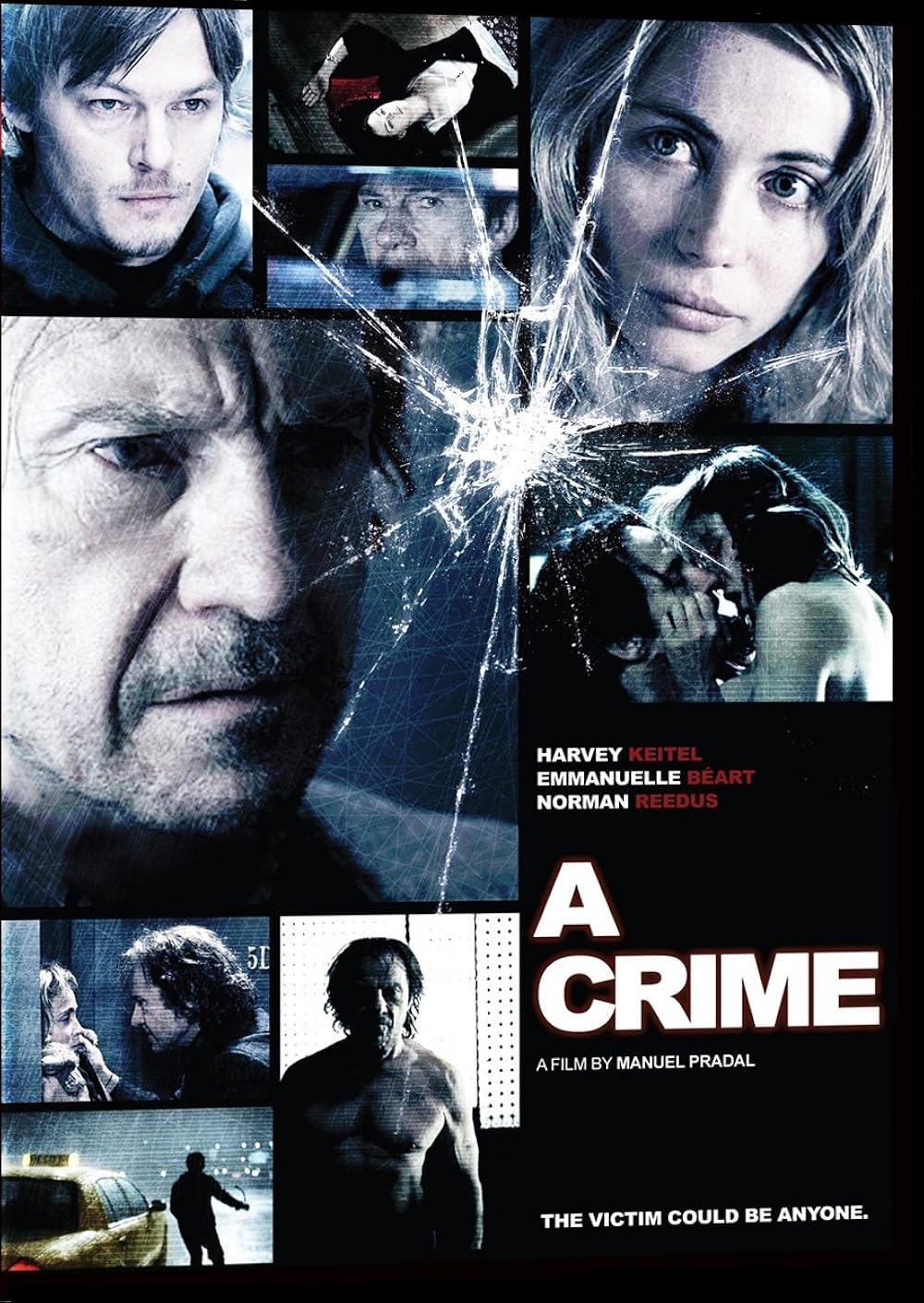
Vincent (Norman Reedus) is haunted by nightmares of an evening three years earlier. He was on his way home and nearly collided with a taxi just outside his house. Moments later, he found his wife bleeding to death on the kitchen floor. He becomes consumed by a desire for revenge, yet the only clues he can recall are that the taxi driver wore a red T-shirt and a large ring on his finger.
Alice (Emmanuelle Béart), Vincent’s neighbor, has other ambitions. Rather than watching him bury himself in the past, she wants him to open his eyes to her. She decides to track down what Vincent is searching for — regardless of whether this requires manipulation and fabrication, even to the point of constructing a scapegoat for the violent act.
The back cover describes this as a thriller, as does IMDb, but I would argue that its dramaturgical core lies closer to a triangular relationship drama. There is no nerve-shredding suspense, nor is there a crime to solve in any conventional sense, despite the film’s title. What does exist, however, is a persistent curiosity — a desire to know what will happen next. Not because the film conceals grand mysteries, but because it invites confirmation of the theories the viewer continuously formulates as the narrative unfolds.
Alice’s motives in positioning the taxi driver Roger Culkin (Harvey Keitel) as a scapegoat do not require deep excavation to grasp. They emerge gradually, but her objective is fairly clear early on. What is less obvious, however, are the emotional stakes she gambles with. She has a goal — but what does it ultimately cost her, psychologically? Does she attain happiness, or is the price of that presumed happiness far too high?
Roger’s intentions, by contrast, are not as transparent — nor is his character. There is an enigmatic quality about him that prompts the question of whether he may, in fact, have been involved in the original crime after all. This ambiguity is a productive complication; it lends the film an additional dimension. It also generates further questions: Is he merely toying with Alice, or is he genuinely in love with her? Does he realize he is being manipulated? Surely he does — but at what point?
The performances are strong across the board, and the third central role — Vincent — is no exception. Does he recognize his obsession with revenge, or does it pass him by unnoticed? Perhaps he invests far too much emotional energy in his dog, Vicky, to fully comprehend the extent of his own deterioration.
There are many questions, and while answers may be found within the film, they are primarily located in the subjective interpretation each viewer brings to it. Different individuals will inevitably arrive at different conclusions, depending on where they themselves happen to stand in life. Nothing is definitively right or wrong — only personal readings of the emotional states the characters embody.
A well-acted film with a complex screenplay.
About the Author

Tommy Snöberg Söderberg
Administrator
Autodidact film scholar and music-loving thinker who reads the occasional book.


