
 Tommy Snöberg Söderberg
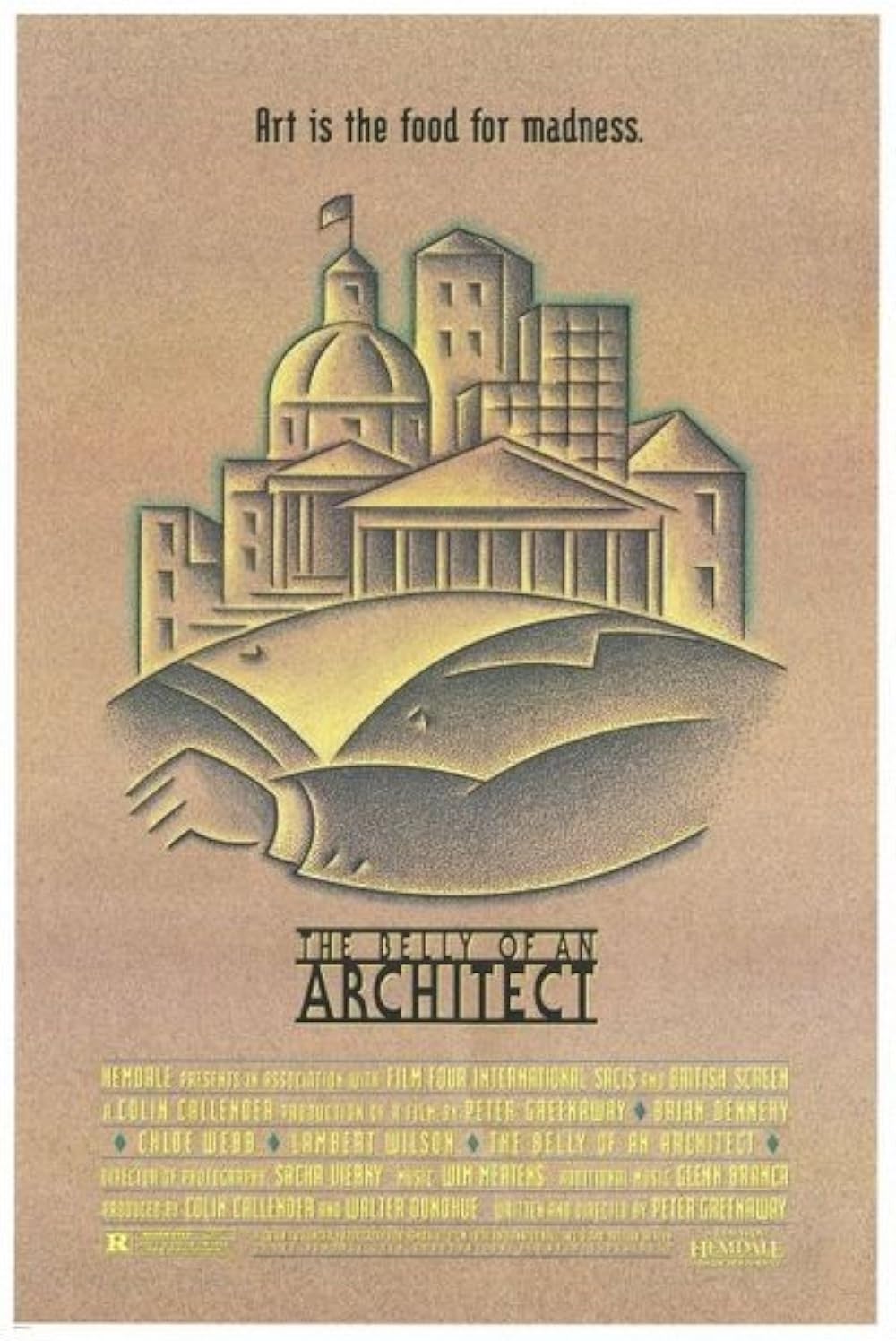
The architect Stourley Kracklite arrives in Italy with his wife to oversee an exhibition devoted to a French architect, Boullée. Soon he starts to worry about his stomach; he is convinced that something is wrong with it, cancer or poisoning or something else that means he is dying. He even believes that his pregnant wife is behind it. He becomes obsessed with this, and the more things go against him, the bigger his problems get. A competitor whom Kracklite dislikes seems to be trying to take over the exhibition by any means necessary, and not only the exhibition; he is making advances on Kracklite’s wife as well. Eventually everything around Kracklite is in flux; he no longer has any idea what is going on, and he seems mostly preoccupied with his own ego and with fighting tooth and nail to keep his competitor from stealing the show from him.
Already in some of the first scenes I take issue with the fact that the film seems to consist of badly executed scenes in front of a blue or green screen. It bothers me quite a bit, but since the film is from the ’80s after all, I choose to give it the benefit of the doubt. I also notice quickly that I am much more interested in the film than I ought to be. The subject of an architect developing stomach trouble is not exactly fun, perhaps, but somehow it becomes immensely interesting to see what will happen anyway. Brian Dennehy does a fantastic job as the tormented architect, and I must admit that I did not think he had that kind of acting ability in him! Truly impressive! What is interesting is not the stomach trouble either, whether Kracklite has been poisoned by figs or not. It is the backstory itself that is essential: the arrogance he displays and the spiral of decadence he seems to descend into. Everything is taken from him in one way or another, and he is often to blame himself. In the end nobody can put up with his manner, and eventually he is stripped of the honor of leading the exhibition.
His wife disappears from his life, and in the end nothing is left of his own life either. He has lost everything. This is no spoiler in any way, and the information can be found on the back of the cover anyway. No, how it will end is obvious! What is interesting are the paths the ultimate decline takes.
There are comic passages here and there, and it is not quite a full-blooded drama. And that is probably a good thing, I guess, since it might have become a bit too heavy if there had been no chance to catch your breath along the way. As it is, it is an entertaining film that does not necessarily linger in the mind for very long, but I feel that I must explore Peter Greenaway’s work a bit more going forward!
About the Author


 Del Gibson
