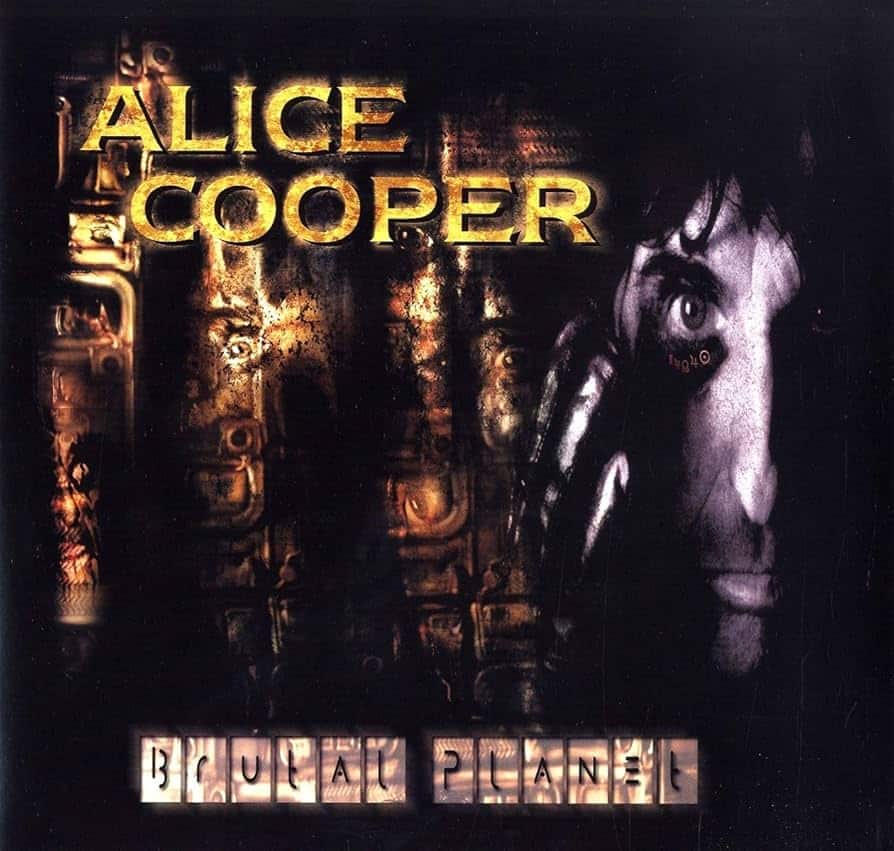
Alice Cooper – Brutal Planet – 2000
As can be seen, there were no less than six years between the previous album, The Last Temptation, and this one — which is, of course, an awfully long time in this context. But just as large as the gap between the albums is, the musical difference between them is equally substantial.
If The Last Temptation was merely brushing against the outer edges of heavy metal, Alice Cooper takes the full step into the genre here. Already in the opening title track, Brutal Planet, we are presented with a far darker sound than before, and it takes a few listens before one truly comes to terms with the music.
The lyrics are equally dark and reflect the album’s overall theme. According to the record, we inhabit a bleak world. Yet even though the atmosphere is filled with gloom and misery, there is more of a tongue-in-cheek attitude here than on the preceding The Last Temptation, which perhaps came across as somewhat more pretentious than anything Alice had previously done. The tone is set immediately in the opening lines of the title track:
We’re spinning round on this ball of hate
There’s no parole, there’s no great escape
We’re sentenced here until the end of days
And then my brother here’s a price to pay.
And just like that, we find ourselves deep in the valley of despair.
One amusing detail is how Alice reconnects both to the previous album and to even earlier material through lyrical references and similar devices. In the song Gimme, for instance, the lines
There is one thing
I mean everything has a price
I really hate to repeat myself
But nothing’s free
It must surely be a nod to the previous album’s Nothing’s Free. Meanwhile, in It’s the Little Things, the connection becomes explicit with the lines:
I’m on some thin ice
You push me too far
Welcome to my nightmare
No more Mr. Nice Guy.
For the most part, however, the album deals with dark lyrics in a dark world, and the level of violence easily rivals that found on Raise Your Fist and Yell. The cynicism is unmistakable, sometimes even explanatory, as in Wicked Young Man:
It’s not the games that I play
the movies I see
the music I dig
I’m just a wicked young man.
Of course, this line can be interpreted in various ways. My own interpretation may be somewhat personal, but I tend to believe that external influences do not necessarily shape a person as much as is often claimed. Rather, the opposite may be true: one is who one is, and therefore gravitates toward a certain type of film or music. I do not believe these influences drive people to commit violent crimes — but that discussion has been debated for so long that I hardly intend to present any universal solution here.
Finally, I must mention the album’s black sheep — not because it is weaker than the rest of the material, quite the opposite — but because it deviates somewhat from the concept, at least musically. Take It Like a Woman flirts with the sound of Alice’s earlier years and could almost be interpreted as a kind of spiritual continuation of Only Women Bleed, which once became a fairly successful hit and is now widely regarded as one of Alice’s classics.
It may well be the best song on the album, although it lacks the kind of immediate hook that would make it fully effective in that sense. In that regard, Sanctuary probably takes the prize.
In any case, this is an album that benefits from repeated listening. The first time I heard it, I was undeniably disappointed. Nowadays, however, I consider it genuinely good — even if it cannot quite be counted among the very top tier of Alice Cooper’s discography.
About the Author

Tommy Snöberg Söderberg
Administrator
Autodidact film scholar and music-loving thinker who reads the occasional book.